
 Brooklyn Letters
1139 Prospect Avenue, Brooklyn
-
We would highly recommend Ally! Our son always asks about her, so very thankful to Brooklyn Letters for introducing us.
~ Emily, mom of Brooklyn 2 year old -
I cannot express how grateful and rewarding my experience with Brooklyn Letters has been. Her tutor Ms. Daria is so knowledgeable, amazing, kind and awesome. My daughter has made so much progress in Literacy and Math and it's all … More thanks to Ms. Daria. I know my daughter is sad that she can no longer work with Ms. Daria, as she looked forward to their sessions every week. Thank you again!
-
Nicole has been an amazing therapist!! She played a tremendous role in our daughter’s speech progress and overall development. She has come such a long way and we are so happy with the therapy she received!
-
We could not be happier with the services Valerie provided! She is very thoughtful and knowledgeable and provided significant guidance to support our daughter's speech development outside of our scheduled sessions. She established … More a great working relationship with her, and she will definitely be missed! Your business model is amazing and it was an absolute pleasure working with Valerie. I've referred your organization and Valerie to the Executive Director of our daughter's school and friends/colleagues who are in need of speech therapy services.
-
Christina was absolutely wonderful. She went out of her way to win my son over and it worked. He looked forward to her visits and his speech improved so much under her care. She was super flexible and it’s clear she truly cares. We adore … More Christina and we’re going to miss her. Almost sad he improved so much! She’s simply amazing and we can’t say enough how great she is. I would recommend her services to anyone and everyone, without hesitation. Thank you so much for connecting us with her!
-
We cannot say enough good things about Effie, the ASL teacher, who was so engaged and effective with our 2 year old daughter from the very first session! Effie gladly included our whole family in the sessions! Her expertise and fantastic … More personality gave our daughter a way to communicate that she was so desperately seeking. The coordinators at Brooklyn Letters were so helpful and communicative…I would highly recommend their services!
-
Samantha Dalmas was fantastic! We saw her for a feeding therapy evaluation and while she doesn’t think my daughter needs more feeding therapy sessions at this time, but she gave me lots of tips to try. If my daughter's doctors want … More to see more progress at her next appointment, I wouldn’t hesitate to reach out to Samantha again.
-
Brooklyn Letters was recommended to me through a friend's speech therapist friend in NJ. The articulation evaluation for my daughter went well. We were pleased with Kristin's services.
-
Melissa was wonderful. Our daughter warmed to her immediately and by the time she left, had already started "practicing" some of the techniques Melissa had shown her. I will not hesitate at all to reach out to Melissa again, should … More the need arise.
-
Aileen was INCREDIBLY helpful to us, both in assessing possible origins of my grandson's food aversions, as well as informing us of various available interventions to consider.
I can’t thank you and Brooklyn Letters enough for connecting … More us with Aileen. In all our feeding therapy journey we have not gotten anything near the kind of benefit that we did from her. Her knowledge, professionalism, and responsiveness have put us on the path of progress with my grandson and has also made us feel genuinely well cared for. -
We were amazed with Allison! She met my son at 2 1/2 years old, not speaking much at all, and over a computer, and she was able to develop a bond and friendship, so much so that he would look forward to his weekly computer time with Allison. … More I was not sure how the speech therapy would go- but we are so happy that we tried it out and continued. It allowed my son to gain confidence in his speech, make a new friend :), and also give him the skills and a bit of understanding of how to shape his mouth or where to place his tongue to make the proper sounds. We were extremely happy with Allison- she was fantastic to work with.
-
My sessions with Karen have been extremely helpful. My speech has improved tremendously. In fact, I just finished 2 hours of conducting interviews with a consulting client via MS Teams and I have an upcoming conference call. Both my … More neurologist and neurosurgeon remarked about how good my speech is. Much of the day it is perfect, although I still have some rough spots when I get tired or speak too quickly. One of my granddaughters is a speech pathology student at Ithaca College. She sat in on 2 sessions while she was home for winter break, and she was very impressed with Karen.
-
 We were delighted with Christie. First, and most importantly, our son made great strides under her guidance. So great, that we felt he no longer needed help! She was incredibly patient and kind with him and our son really responded to … More her. Christie was also great with me and my wife. She provided thorough and informative updates on our son's progress and which exercises she was using with him, so we could reinforce what she was teaching him. All in all, we had a fabulous experience with Christie and would highly recommend her.
-
Theo was wonderful and his work with my son has produced some progress. I am grateful for the services Theo provided.
-
Highly recommend Jill. She is a total pleasure to work with. After a few months working with Jill, my son is reading above grade level and LOVES to read. Mission accomplished!
-
Paige was great and we had been really happy with her. I would highly recommend her! I recommend Brooklyn Letters to whomever asks for a speech therapist.
-
Isabel was WONDERFUL and our son absolutely adored her, and he is making great progress with his reading and writing.
-
Theo was fantastic with our 4yo son. We were very worried that his progress would fall off when we had to switch to remote sessions, but Theo kept our son happy and engaged through the screen. Highly highly recommend!
-
We've been working with Theo from Brooklyn Letters for close to 4 months now and the results are apparent; our daughter has vastly improved her speech in a relatively short amount of time. We make "Theo Day" a celebration … More in our house with pancakes for breakfast, and the enthusiasm is matched in the sessions. Theo is fun, patient, professional, and caring, and he gives us the tools to take the lessons beyond the session. Thank you Theo, and Brooklyn Letters, for helping our daughter express herself.
-
 I worked with Alina to enhance my pronunciation, tone, and pacing while communicating socially and in a work environment. She was great to work with and clear about goals and learning objectives. The improvement from day 1 has been tremendous! … More
-
Cathy has been excellent with us and our son. We will sorely miss her. He has improved significantly with Cathy’s help. Cathy was a true partner with us, especially as we pursued additional help through our son’s school system.
-
 We really loved working with Alina, she is so fantastic. Patient yet firm, and determined the best course of action very clearly and succintly for us. And it all transitioned so well to Zoom as well. I will definitely be back in touch for … More services for our other child after summer break!
-
 Vera was amazing! My 11 yo daughter made progress so quickly and really looked forward to her sessions. She was kept motivated and engaged.
-
 The work that Allison P. did with our daughter over the years has been invaluable to us. Our daughter had such a good relationship with Allison, and it allowed them to work really well together - even remotely these past 6 months. This … More year, Allison went above and beyond by helping us throughout the neuropsych eval we did, trying to re-open our daughter's IEP at her school, and eventually landing her at our chosen school. She was in contact with our daughter's teachers, with the neuropsychologist, and made herself available as a reference to speak on behalf of our daughter's learning differences.
Allison stopped by our house last week to give our daughter cupcakes and say goodbye, and I literally cried with appreciation for what an amazing speech therapist she has been. She has been our daughter's biggest champion. The new families that she will work with this year are lucky to have her. -
 Sydney was great! Our son was sad to end his sessions with her, which says a lot. We appreciated her honest assessment of his skill level, and he now has materials to self monitor and practice. Thank you!
-
 Our experience with Theo was terrific. Theo was great with my son. He developed a positive relationship with him based on sincerity, respect, trust and a deep personal connection. In their lessons, Theo was encouraging, creative and kind. … More He helped our son understand how to differentiate the sounds he made when he spoke, and gave him great exercises to practice every week between lessons. Our son was sorry to have the lessons come to an end, but recognized that Theo had helped him as much as possible and it was time for him to stop. Theo explained to him (and us) how to keep working to get the last 5%, and encouraged him to keep working on the exercises on his own. I have recommended Theo to another parent who noticed my son's improvement and inquired for her own son.
We are all grateful to have gotten to know Theo, and we greatly appreciate all the work he did to help our son. -
 "I have nothing but wonderful things to say about Michelle Macroy-Higgins. We are extremely pleased with her work with our daughter. I was so grateful for my daughter to have a speech therapist who is a researcher (specialty in late … More talkers), graduate professor and practitioner. Her expertise was clearly evident in our conversations and work with our daughter. She was very responsive to my questions and often sent articles and other materials about language development that I found helpful. Thankfully, my daughter's speech improved tremendously. Michelle developed such a warm relationship with my daughter. My daughter was always excited to see Michelle and would greet her at the door with a big hug. Lastly, I would add that Michelle always demonstrated empathy with me as a mother who was initially worried about her daughter's language development. I could go on and on about how pleased we were with Michelle's work."
-
 Theo is a wonderful Clinton Hill speech therapist. We were really pleased with him. Our son showed drastic improvement, not only in his speech but in his confidence.
-
 Alexa has been an enthusiastic, reliable, well prepared and caring teacher for our 6 year old daughter. She has been able to improve and increase our daughter's confidence lesson by lesson with patience and competence; through varied … More and productive didactic practice. Alexa has engaged our daughter in several activities that always kept her motivated and eager to learn literacy. My wife and I, both of us are educators, feel so fortunate to have had the opportunity to observe Alexa's pedagogical skills. Alexa has had a big impact on our daughter literacy growth. Thank you Brooklyn Letters!
-
 We were absolutely DELIGHTED with Marsha's services. She was wonderful. We found her to be kind, fun, engaging, very knowledgeable. She provided us with clear instructions and additional written handouts each week. She engaged our … More son with different techniques and toys, and showed us how to use her techniques when we were interacting with him. I actually just texted her on Saturday - Our son finally said "more" - one of the target words we had been working on with her. It was a total joy to hear, and I had to share it with her - she wrote back immediately to congratulate us. I am so appreciative of her expertise, and wish we could have seen her for longer. I recommended her to another family in our neighborhood who is looking for a speech therapist.












Yelp (also view our 35+ filtered reviews)
What “Boat” and “Rain” Have in Common That School Didn’t Teach

Most kids learn to read in a fairly predictable sequence. First come the alphabet letters, then short vowel sounds, then simple CVC words like cat, dog, and run. It feels like progress. Then, somewhere around first or second grade, many children hit a wall. Words like rain, boat, feet, and coat suddenly don’t follow the rules they were given.
A child who could read hat perfectly well stares at rain and tries to sound out each letter separately: /r/ /a/ /i/ /n/. It doesn’t work, and they have no idea why.
What they’re running into is one of the most common and least explicitly taught features of English phonics: the vowel team.
What a Vowel Team Actually Is
A vowel team is when two vowel letters appear side by side and together produce a single sound. In rain, the letters a and i don’t each make their own sound. They team up to make the long /a/ sound. In boat, the o and a do the same thing, producing a long /o/. In feet, the double e makes a long /e/. Same concept, different letters.
Linguists call this a digraph, a technical term for any two letters that represent one sound. Vowel digraphs and vowel teams are used interchangeably in reading instruction, though “vowel teams” is the more classroom-friendly phrase.
What makes this tricky is that English has far more vowel sounds than vowel letters. The five letters a, e, i, o, and u are expected to represent somewhere around 20 distinct vowel sounds in standard American English. The alphabet was never going to cover that on its own. Vowel combinations exist precisely to fill that gap, which is why they appear in such a large portion of everyday vocabulary.

What the Research Actually Agrees On
Before getting into specific programs or instructional resources, it’s worth anchoring this in what the research base itself shows.
A U.S. Department of Education reading resource lays out the foundational case for systematic phonics instruction: children need explicit teaching in how letters and letter combinations map onto sounds, not incidental exposure through reading alone.
That conclusion holds up under closer scrutiny, too. A reanalysis of the National Reading Panel’s findings, published via NIH’s National Center for Biotechnology Information, confirmed that the effects of systematic phonics instruction are not just statistically real but practically meaningful for reading outcomes. Separately, a longitudinal study of children’s early word decoding found that during the first months of systematic phonics-based instruction, children explicitly learn that written words are made of graphemes that correspond to phonemes — and that this explicit mapping is where decoding skill takes hold, especially for children who are already at higher risk of falling behind.
Three consistent threads run through this literature:
- Phonics instruction works best when it’s explicit and systematic, not incidental
- Decoding skill is built through direct teaching of letter-sound patterns, not repeated exposure alone
- Gaps in this instruction show up earliest and most clearly for children already at risk for reading difficulty
That’s the evidence base. Everything else in this article — instructional explanations, teaching strategies, examples of how services apply this — sits downstream of it, not alongside it.
The Gap Between Phonics Basics and Vowel Teams
For a plain-language breakdown of how vowel teams work mechanically, Voyager Sopris Learning’s explainer on vowel teams is a useful reference for parents trying to understand what their child is encountering — worth noting this is an instructional explainer from an edtech company, not a research study, but it does a clear job of breaking down the mechanics: vowel teams like ai, ea, oa, ee, and oo each produce consistent, learnable sounds.
But the catch is that consistency isn’t total. The pair ea, for example, makes a long /e/ in meat but a short /e/ in bread. The oo combination makes different sounds in book versus moon. The ow in snow sounds nothing like the ow in cow.
This is why decoding difficulties are so common at the point when vowel teams enter the picture. A child who has been taught that vowels make specific sounds now encounters letter pairs that behave as a single unit, and sometimes that unit has more than one possible sound. Without explicit instruction in these patterns, guessing becomes the default strategy. And guessing, over time, builds bad habits that compound.
The old classroom rhyme “when two vowels go walking, the first one does the talking” gets repeated often, but researchers have noted it simply doesn’t hold up often enough to be reliable. The ea in bread disproves it immediately. Teaching the rule without teaching its many exceptions sets children up for exactly the confusion many parents see at home during reading practice.

The Most Common Vowel Teams and What They Do
It helps to have a concrete picture of the landscape. These are the vowel teams that appear most frequently in English text:
- ai / ay make the long /a/ sound (rain, train, day, play)
- ee / ea typically make long /e/ (feet, sleep, tea, meat) though ea can also make short /e/ (bread, head)
- oa / oe make long /o/ (boat, coat, toe, hoe)
- oo makes two distinct sounds: long /oo/ as in moon and short /oo/ as in book
- oi / oy make the same sound: /oy/ (coin, oil, boy, toy)
- ou / ow are especially variable: long /oh/ in snow, /ow/ in cow, and several other values depending on surrounding letters
A subset of vowel teams are called diphthongs. These aren’t simply two vowels holding a single, steady sound. A diphthong is a gliding sound, where the mouth actually shifts position mid-vowel. The /oi/ in oil and the /ou/ in house are diphthongs. The distinction matters in structured literacy programs, though for most parents the simpler takeaway is this: some vowel teams are stable, some shift, and all of them require direct teaching.
Why This Shows Up in Spelling Too
A child who struggles to read vowel teams will almost always struggle to spell them. Reading and spelling are two sides of the same skill. When decoding, a child moves from print to sound. When spelling, they move from sound to print. Both directions require knowing the pattern.
This is the root of why so many children spell rain as ran, raan, or rane. They hear the /a/ sound, which they’ve associated with a single letter, and they reach for the closest match they know. The problem isn’t laziness or carelessness. It’s that nobody has taught them the specific pattern that represents that particular /a/ sound in that word.
Spelling and encoding difficulties of this kind respond well to structured, pattern-based instruction — a point directly supported by the phonics research cited earlier, which found that explicit, systematic, cumulative instruction produces stronger decoding and encoding outcomes than instruction that’s incidental or embedded in reading alone.
What Explicit Instruction on Vowel Teams Looks Like
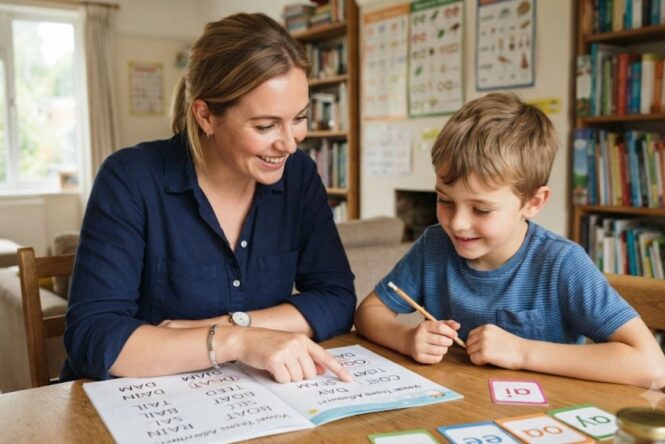
Here is what direct vowel team teaching involves in practice:
- Introducing one vowel team at a time, starting with the most consistent ones (ai, ee, oa)
- Reading and spelling practice with real words that use the target pattern
- Sorting activities where children categorize words by their vowel team
- Connecting the visual pattern to the sound it reliably makes before introducing exceptions
- Multisensory work: saying the sound while writing the letters, building words with letter tiles, marking vowel teams with a visual cue
Structured literacy programmes, including Orton-Gillingham and Wilson, build vowel teams into their sequence deliberately. They don’t leave it to discovery. Each pattern is introduced, practised in isolation, and then reinforced in decodable reading passages where that pattern recurs.
Practical Implementation Examples
The principles above show up in different forms depending on the setting. As one example of how private tutoring services apply structured literacy principles to this specific skill area, Brooklyn Letters works with children on decoding and, separately, on spelling/encoding using explicit, pattern-based instruction along the lines described above. This is one illustration of how the research translates into practice, not a research citation in itself — the evidence for why explicit instruction works comes from the sources in the research section above.
When to Look Closer
Not every child who misreads a vowel team has a learning difference. Vowel teams are genuinely difficult, and many children need more time with them than classroom phonics instruction provides. But if a child is consistently guessing at words rather than attempting to decode them, reversing vowel teams in spelling, or avoiding reading aloud, it’s worth taking a closer look.
Reading difficulties tied to phonics gaps, including those associated with dyslexia, often show up most clearly at the point where decoding has to get more sophisticated. Vowel teams are one of those inflection points. Earlier gaps that went unnoticed tend to surface here.
The good news is that these patterns are learnable at any age. They require deliberate instruction, appropriate practice materials, and a tutor or specialist who knows how to sequence the teaching. That’s exactly the kind of targeted support that makes a measurable difference, far more than generic reading time or hoping the child will catch up on their own.
If boat and rain are causing problems, they are pointing at something specific. That specific thing has a name, a clear explanation, and a well-researched instructional path. The sooner it gets addressed, the easier the rest of reading becomes.
FREE CONSULTATION!!!
Call: (347) 394-3485, Text: (917) 426-8880
Email: info@brooklynletters.com
(we respond to email right away!)


Craig Selinger
Latest posts by Craig Selinger (see all)
- How Teachers Use Sound Buttons to Teach Digraphs and Tricky Words - September 15, 2026
- What “Boat” and “Rain” Have in Common That School Didn’t Teach - July 8, 2026
- SUMMER READING ACCELERATOR - June 13, 2026
