
Why Can My Family Understand My Child but Others Can’t? | Brooklyn Letters

Everyone in the Family Understands My Child—Why Doesn’t Anyone Else?
At home, your child talks constantly.
They tell you about the dinosaur they built from blocks. They explain why the family dog stole their sock. They ask for “the blue cup, not the red one,” and proudly describe every detail of the picture they made at preschool.
You understand every word. Conversation feels effortless. In fact, you rarely think about your child’s speech at all.
Then something unexpected happens.
A grandparent asks, “Can you tell me what they said?”
A cashier smiles politely and replies, “I’m sorry…could you say that again?”
At preschool pickup, your child’s teacher looks toward you after asking a question, almost expecting you to translate.
Suddenly, you begin noticing something you hadn’t before. Your child sounds perfectly clear to your family—but not to everyone else.
Questions quickly follow:
- “Why can we understand everything they say?”
- “Is my child speaking differently around other people?”
- “Should I be worried if strangers have trouble understanding them?”
These are some of the most common concerns parents discuss with speech-language pathologists. The reassuring news is that this situation is very common. In many cases, children are speaking exactly the same way at home as they do everywhere else. The difference often lies with the listener—not the child.
Parents, siblings, and other close family members spend thousands of hours listening to a child’s speech. Over time, they naturally become experts at understanding that child’s unique pronunciation patterns. Someone meeting your child for the first time doesn’t have that advantage.
Understanding why familiar listeners hear speech differently helps parents better recognize when speech development is progressing typically and when it may be helpful to seek guidance from ASHA.
Rather than asking, “Why doesn’t anyone else understand my child?” it can be more helpful to ask, “How understandable is my child’s speech to people who don’t hear them every day?”
That question focuses on what speech-language pathologists call speech intelligibility—one of the most important indicators of how easily children communicate in everyday life.
In this article, you’ll learn:
- why families often understand their child better than everyone else
- what speech intelligibility means
- how speech sounds typically develop
- why unfamiliar listeners sometimes struggle more than parents
- signs that unclear speech in toddlers and young children may deserve a closer look
- practical ways to support clearer communication at home
- when an evaluation for a potential speech sound disorder or articulation disorder may be helpful
- how Brooklyn Letters helps children build clear, confident communication through specialized speech-language therapy NYC programs
The goal isn’t perfect pronunciation. It’s helping children communicate confidently with everyone they meet—not just the people who know them best.
Key Facts
- Families naturally become highly skilled at understanding their own child’s speech patterns.
- Speech intelligibility refers to how easily a child’s speech can be understood by other people.
- Young children are expected to make some pronunciation errors while speech sounds are still developing.
- Speech clarity should gradually improve as children grow and gain experience using speech sounds.
- If unfamiliar listeners consistently struggle to understand your child because of child pronunciation problems, a speech-language evaluation may help determine whether
development is progressing as expected.
Quick Answer: Why Can My Family Understand My Child but Other People Can’t?
Parents and close family members hear their child’s speech every day. Over time, they naturally learn to recognize pronunciation patterns, anticipate certain speech sound substitutions, and understand words that unfamiliar listeners may find difficult to interpret.
Someone hearing your child for the first time doesn’t have this experience. Because they don’t know what your child is trying to say, even small pronunciation differences can make speech much harder to understand.
This doesn’t automatically mean something is wrong. However, if teachers, relatives, or unfamiliar adults frequently struggle to understand your child beyond what would typically be expected for their age, it may be helpful to discuss your concerns with a speech-language pathologist.
Families Become Experts at Understanding Their Own Children
Think about meeting someone with a strong regional accent. The first conversation may require extra concentration. You may need them to repeat a few words.
After spending more time together, however, understanding becomes much easier. You haven’t changed. Neither has the speaker. Your brain has simply learned to recognize their speech patterns.
Something remarkably similar happens within families. Parents hear their child’s voice every single day. They hear thousands of conversations over months and years. Without realizing it, they begin recognizing:
- predictable sound substitutions
- favorite words and phrases
- common pronunciation patterns
- unique speech rhythms
- the topics their child usually talks about
- familiar expressions and routines
Eventually, parents stop noticing many speech differences altogether. Communication feels natural because their brains automatically interpret what the child intends to say. This adaptation is a wonderful part of close family relationships. It also explains why parents are sometimes surprised when other people have difficulty understanding the exact same speech.
Information Gain: Familiar Listeners Use Much More Than Speech Sounds
When parents understand their children, they aren’t relying only on pronunciation. They’re also using years of background knowledge.
For example, parents already know:
- their child’s favorite toys
- daily routines
- common requests
- family nicknames
- favorite foods
- recent experiences
- typical sentence patterns
Imagine your child says something that sounds like: “Wan da boo.” A stranger has almost no clues. A parent, however, may immediately recognize that the child is reaching toward the bookshelf and saying, “Want the book.”
Parents naturally combine facial expressions, gestures, eye gaze, context, previous conversations, and familiar pronunciation patterns to understand communication quickly. Unfamiliar listeners don’t have access to these helpful clues. They rely much more heavily on speech clarity alone.
Information Gain: Parents Gradually Adapt Without Realizing It
One reason speech concerns sometimes go unnoticed is that changes happen gradually. Children’s speech develops little by little over months and years. At the same time, parents continuously adapt to those changes.
This means families rarely experience the same communication challenge a stranger does. Instead, understanding grows alongside the child’s speech development. Many parents don’t realize how much they’ve adapted until someone unfamiliar says, “I’m sorry—I didn’t understand.”
That moment often surprises families because, from their perspective, communication has been working perfectly well all along. This isn’t because parents are overlooking problems. It’s because human brains naturally become highly efficient at understanding familiar speech. Recognizing this helps parents evaluate communication from a broader perspective rather than relying only on conversations at home.
Information Gain: Understanding Is Different From Speech Clarity
Parents sometimes assume that because they understand every word, their child’s speech must be completely clear. In reality, understanding and speech clarity are not exactly the same thing.
Understanding is influenced by:
- familiarity
- context
- shared experiences
- gestures
- expectations
- previous conversations
Speech clarity—or speech intelligibility—focuses on something different: How easily can someone unfamiliar understand what the child says without extra clues?
This distinction is important because children spend much of their day communicating with teachers, classmates, relatives, coaches, babysitters, neighbors, and community members. The easier they are to understand in these situations, the easier it becomes to participate in conversations, answer questions, build friendships, and express ideas confidently.
Speech Sounds Develop Gradually
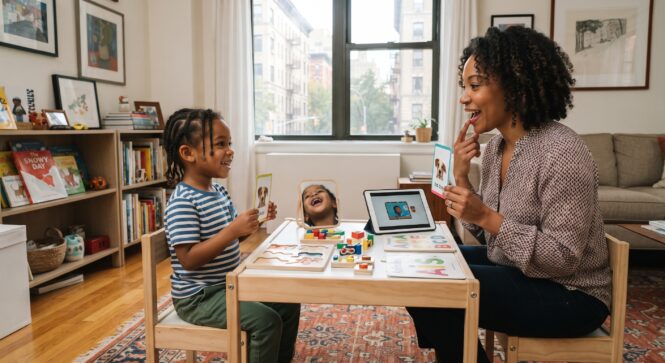
One of the biggest misconceptions about children’s speech is that they should pronounce every word clearly from the moment they begin talking. In reality, learning to speak clearly is a long developmental process. Children aren’t born knowing how to coordinate the dozens of tiny muscles involved in speech.
Every spoken word requires remarkable precision. Children must:
- move their lips accurately
- position their tongue correctly
- coordinate their jaw movements
- control airflow
- produce voice at the right moment
- combine individual sounds into complete words
Adults perform these movements automatically. Young children are still learning them. That’s why it’s perfectly typical for preschoolers to simplify certain sounds while their speech system continues developing.
For example, younger children may:
- replace more difficult sounds with easier ones
- leave off sounds at the ends of words
- simplify longer words
- occasionally pronounce the same word differently on different days
These patterns are often part of normal speech development. As children’s speech muscles mature and they gain more experience talking, pronunciation generally becomes clearer and easier for others to understand.
The important question isn’t: “Does my child pronounce every sound perfectly?” Instead, it’s: “Is my child’s speech becoming easier to understand over time?” Steady improvement is usually much more meaningful than perfect pronunciation at a particular age.
Learning to speak clearly is a complex motor process that unfolds over years. To see if your child’s current speech patterns match typical milestones, you can review our guide on child speech development warning signs
Information Gain: Learning Speech Is Like Learning Any Other Motor Skill
Parents often think of speech as something children simply “pick up.” In reality, speech is one of the most complex motor skills children ever learn.
Imagine learning to play the piano. At first, every finger movement requires concentration. With practice, movements become smoother and more automatic. Speech develops in a remarkably similar way. Children practice thousands of words every day, and each conversation helps strengthen the coordination needed for clearer speech.
Understanding Speech Intelligibility
When speech-language pathologists talk about how understandable a child’s speech is, they often use the term speech intelligibility.
Speech intelligibility simply means: How easily can another person understand what a child says?
Notice that this isn’t the same as asking whether every sound is produced perfectly. A child can make a few pronunciation errors and still be very easy to understand. Likewise, another child may only substitute a handful of sounds but still be difficult for unfamiliar listeners to follow because those substitutions occur frequently or affect many important words.
What Affects How Easy Speech Is to Understand?
Speech intelligibility depends on many different factors working together, including:
- speech sound development
- pronunciation of individual sounds
- the number of sounds affected
- sentence length
- vocabulary complexity
- speaking rate
- voice quality
- attention and listening environment
- how familiar the listener is with the child’s speech
For example, a child speaking quietly in a noisy classroom may be much harder to understand than when speaking slowly with one familiar adult at home. Likewise, children often become less clear when they are excited, tired, upset, speaking very quickly, or trying to tell a long story.
Signs That Others May Be Having Difficulty Understanding Your Child
Many parents first become aware of a speech concern not because they have trouble understanding their child, but because someone else does. Perhaps your child’s preschool teacher gently mentions that classmates sometimes ask for repetition. A grandparent smiles and says, “Can you tell me what they meant?” Or another child responds with, “Huh?”
These moments can be surprising because conversations at home usually feel effortless. This is one reason speech-language pathologists encourage parents to consider how well a child communicates with both familiar and unfamiliar listeners across everyday environments like school, playdates, and family gatherings.
Signs Your Child May Benefit From a Speech Evaluation
Children naturally develop speech sounds at different rates, and many pronunciation differences disappear as children grow. However, it may be worthwhile to speak with a speech-language pathologist if you notice that:
- unfamiliar adults frequently struggle to understand your child
- teachers regularly mention concerns about speech clarity
- relatives often ask you to interpret what your child says
- classmates frequently misunderstand your child
- your child becomes frustrated when others don’t understand them
- speech seems difficult to understand in everyday conversation
- communication difficulties are affecting friendships or classroom participation
- speech differences continue without noticeable improvement over time
These observations do not automatically mean your child has an articulation disorder or speech sound disorder. Rather, they suggest that a professional evaluation may help determine whether speech development is progressing as expected or whether additional support would be beneficial.
While many children outgrow pronunciation errors, persistent difficulty can impact their confidence. Our specialized articulation therapy focuses on the motor precision needed to help children communicate clearly with everyone, not just family members
Practical Ways to Support Clearer Speech at Home
Parents don’t need to correct every speech error they hear. In fact, constantly asking children to repeat words perfectly can sometimes make conversations feel stressful rather than enjoyable. Instead, focus on creating rich, positive communication experiences.
Repeat Words Naturally
One of the simplest and most effective strategies is called recasting. Rather than correcting your child directly, you simply repeat the word correctly within a natural conversation.
For example:
- Child: “I see a tat!”
- Adult: “Yes! That’s a cat. The cat is sleeping.”
This approach gives children a clear speech model without making them feel corrected or tested.
Slow Down Conversations
Children often become harder to understand when they’re excited. As they rush to tell an exciting story, words may blend together and speech sounds become less precise. Parents can help simply by modeling a slower speaking pace. There’s no need to tell children to slow down; instead, slow your own speech naturally. Children frequently match the rhythm of the adults around them.

How Brooklyn Letters Supports Clear Communication
At Brooklyn Letters, we understand that clear speech is about much more than pronouncing sounds correctly. It’s about helping children communicate with confidence wherever life takes them.
Whether they’re answering a teacher’s question, making a new friend on the playground, telling a grandparent about their day, or sharing an exciting idea at dinner, children deserve to feel understood. That’s why our speech-language pathologists look beyond individual speech sounds to evaluate each child’s complete communication profile.
Our approach looks at the child’s complete communication profile rather than just isolated sounds. We provide comprehensive NYC speech-language therapy tailored to help children find their voice and feel understood in any environment
Frequently Asked Questions
Why can I understand my child perfectly when other people can’t?
Parents and close family members hear their child’s speech every day. Over time, they naturally learn to recognize pronunciation patterns, anticipate common word substitutions, and use context to understand what the child intends to say. Someone hearing your child for the first time doesn’t have those advantages.
What is speech intelligibility?
Speech intelligibility refers to how easily another person can understand what a child says. It focuses on successful communication rather than perfect pronunciation. A child may make several speech sound errors while still being highly intelligible.
Will my child outgrow speech sound errors?
Many speech sound differences improve naturally as children mature. However, if speech remains difficult for unfamiliar listeners to understand or continues affecting communication over time, a speech-language evaluation can help determine whether additional support would be beneficial.
Call: (347) 394-3485, Text: (917) 426-8880
Email: info@brooklynletters.com
(we respond to emails right away!)


Craig Selinger
Latest posts by Craig Selinger (see all)
- You’re Not Alone: Support for Parents Worried About Their Child’s Learning | Brooklyn Letters - September 14, 2026
- Should I Trust My Gut Feeling About My Child? | Brooklyn Letters - September 11, 2026
- My Child Is Smart but Has Poor Grades | Brooklyn Letters - September 10, 2026
