Educational-based speech language pathology is playing a bigger role in the literacy success of children and adolescents. Related professions and teachers are starting to become more aware of our unique skill set and how we play a critical role in education.
The following document is posted on the American Speech Hearing Association’s website, Literacy Gateway.
Speech-language pathologists (SLPs) have the specialized knowledge and experience needed to identify communication problems and to provide the help that children need to build critical language and literacy skills. SLPs are often the first professionals to identify the root cause of reading and writing problems through a child’s difficulty with language. SLPs help children to build the skills they need to succeed in school and in life.
The American Speech-Language-Hearing Association’s (ASHA) National Outcome Measurement System (NOMS) data indicates that more than 70% of teachers who responded to a survey believed that students who received SLP services demonstrated improved pre-reading, reading or reading comprehension skills. A majority of teachers also cited improvements in the student’s listening and written language skills and ability to communicate in socially-appropriate ways (pragmatics).
Key elements of a speech-language pathologist’s academic training relating to early language and literacy development include skills to:
* Build and reinforce relationships between early spoken language and early pre-literacy abilities and consider influences of parent-child interactions in early shared storybook interactions;
* Address difficulties involving phonological awareness, memory, and retrieval;
* Teach children to use tactile-kinesthetic and auditory cues in reading and writing;
* Analyze how the language demands of textbooks, academic talk, and curriculum may stress a student’s capabilities at different age and grade levels; and
* Conduct fine-grain analyses of written language, including spelling, to generate intervention that matches the needs of individual students.
How Speech-Language Pathologists Can Contribute
Speech-language pathologists (SLPs) are key members of the team responsible for helping students learn to read and write. SLP’s contribute in the areas of:
1. Prevention—Communicating risk factors to teachers and parents, and working with them to develop programs to help children acquire explicit, age-appropriate knowledge, skills and strategies of the components of language that contribute to reading and writing development.
2. Identifying At-Risk Children—assisting in development and implementation of screening (e.g., instruments and teacher observation checklists) and referral procedures for very young children as well as older school-age children, including modifying procedures to reduce bias (e.g., dynamic assessment techniques and criterion referenced tasks) for culturally and linguistically diverse populations.
3. Assessing—selecting, implementing, adapting, and interpreting assessment tools and methods to evaluate skills in spoken language, reading, writing and spelling.
4. Providing Intervention—collaborating with teachers and families to plan intervention goals and activities, as well as modifying curricula to keep students progressing in the general education curriculum.
5. Documenting Outcomes—establishing a tracking system for identifying new or re-emerging literacy deficits and documenting outcomes of intervention goals and plans.
6. Program Development—directing or participating in teams to develop school or system-wide strategic approaches to early identification and intervention for children with reading deficits.
7. Advocating for Effective Literacy Practices—providing information about literacy development to state and local agencies that plan and evaluate curricula, establish comprehensive assessments and set related policies; educating them about relationships between spoken language and written language (i.e., reading, writing and spelling) and the benefits of collaborative instructional approaches.
8. Advancing the Knowledge Base—conducting scientifically-based research on early literacy development.
Tags: American Speech Hearing Association, ASHA, at-risk children, auditory cues, Brooklyn, Brooklyn Letters, communication problems, critical language, early language, intervention, Language Experts, literacy development, Literacy Gateway, literacy skills, Literary Resource, NOMS, Park Slope, phonological awareness, phonological memory, phonological retrieval, pragmatics, pre-literacy, pre-reading, reading comprehension skills, reading deficits, reading problems, skill building, SLP's, Speech Language Pathologist, speech language pathology, speech pathology, spoken language, tactile-kinesthetic, writing problems, written language

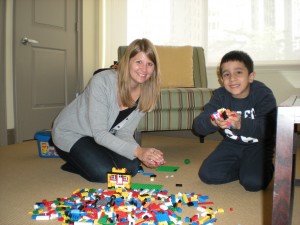
We are pleased to introduce our newest friend, Jai, to the Brooklyn Letters community! Jai and his mother, Varuna, reside in Delhi, India where Jai attended an English speaking school. For the next two months, they temporarily relocated to New York City and Jai will receive intensive speech-language therapy with a focus on literacy development: Craig provides services 1 day per week in his home-based office and Sarah provides services 4 days per week (sessions last 3 hours) in the family’s Manhattan apartment. Jai is a happy, bright, curious, and creative young boy who enjoys reading books, building with legos, playing computer games, and playing with Craig’s very cool pirate ship.
Jai recently participated in an evaluation in Delhi and it was recommended that he receive individualized speech-language and literacy intervention. Jai’s parents were unable to find adequate therapy services in India; they sought out therapy services in the U.S. and Varuna’s friend, in New Jersey, recommendeded Brooklyn Letters. Varuna spoke with Craig and Sarah and they felt that they were an excellent match for Jai. At the beginning of therapy, Jai’s interests, learning style, and strengths and deficits were assessed and baseline skill levels were established. Jai’s individualized treatment plan was developed and the overall goals of therapy are as follows:
• Facilitate Jai’s overall language and literacy skills.
• Work with Jai’s mother to teach strategies to support Jai’s learning, provide activities and materials for work at home, and increase her knowledge of language, literacy, and learning. Click here to see a video of Varuna explaining Jai’s homework.
• Provide suggestions for Jai’s teachers in India to implement in the classroom setting.
• HAVE FUN!

Specific intervention targets include:
1. Increase pre-literacy and literacy skills. To include sound/symbol awareness, auditory discrimination, and rhyming.
2. Increase expressive language skills by using 3-4 word utterances to request, protest, comment, and ask for help.
3. Increase accuracy of comprehension and use of spatial concepts and prepositions (in, out, on, under, next to, behind, in front)
4. Increase memory skills and use of strategies to increase visual and auditory memory.
5. Increase accuracy and speed of word retrieval and recall of information.
6. Increase accuracy of following 2 and 3-step directions.
7. Increase accuracy of response to WH question forms and open-ended questions.
8. Increase accuracy of use of age-appropriate syntactic/grammatical forms (plurals, regular and irregular past tense verbs).
9. Increase categorical and descriptive vocabulary skills.
10. Increase sustained attention to focused tasks.
Within the first week of therapy, Jai made significant progress with his language, literacy skills, and focus. He is producing utterances of increased length, using more complex language forms, and is more confident in his overall abilities. He increased his phonemic awareness skills and is able to identify words that begin with a specific sound. He is demonstrating improved learning readiness by increasing attention to structured tasks, self-monitoring his own level of engagement during activities, and learning spatial concepts, e.g. “under.”
We are excited to have the opportunity to work with Jai and look forward to joining him on his continuing journey of learning, growth, and development of skills! Great job, Jai!
Sarah is a Speech-Language Pathologist who provides home-based assessment and therapy services in the Park Slope and Carroll Gardens neighborhoods of Brooklyn, NY. She specializes in working with children and adolescents who have difficulty with articulation, phonology, language, fluency/stuttering, literacy skill development, pragmatics, and social language. Sarah develops individualized and evidence-based therapy plans that include frequent and ongoing collaboration with parents, caregivers, teachers, and educators in order to maximize the potential of each child. She can be reached at sarah@brooklynletters.com or www.brooklynletters.com
To learn more about Jai’s progress, please read the following blog- http://brooklynletters.com/2010/11/blog/part-ii-india-comes-to-brooklyn-by-sarah-stuntebeck-m-s-ccc-slp-speech-language-pathologist/
www.brooklynletters.com
Tags: auditory discrimination, auditory memory, baseline skill levels, Brooklyn, Brooklyn Letters, complex language, comprehension, descriptive vocabulary skills, expressive language skills, facilitating language skills, facilitating literacy skills, increased literacy skills, increased pre-literacy skills, India, individualized treatment plan, language, Learning, literacy, literacy development, literacy intervention, memory skills, Park Slope, phonemic awareness skills, rhyming, Sarah Stuntebeck Speech Language Pathologist, sound/symbol awareness, spatial concepts, Speech Language Pathologist, speech language therapy, syntactic/grammatical forms, visual memory, word retrieval