Posts Tagged ‘language’

ADHD and Speech/Language/Communication: What’s the Connection?

Monday, February 25th, 2013

ADHD frequently co-occurs with language impairment. Speech and language patterns vary in children with ADHD, but the speech-language pathologist (SLP) can be an important member of the team that helps a child with ADHD maximize his potential and succeed in school and at home. In this workshop, speech-language pathologist Rachel Cortese MS, CCC-SLP, of the Child Mind Institute will discuss the connection between ADHD and speech and language. You’ll also learn about the assessments done by the SLP when a team of professionals diagnoses the disorder, and some of the speech and language treatments available for people with ADHD.

Part of the ADHD Parent and Educator Workshop Series.

Thursday, March 7, 2013
Time: 06:15 PM — 07:30 PM

Child Mind Institute
Fascitelli Board Room
445 Park Ave (entrance on 56th St)
New York, NY 10022

Register for the event here.

Tags: , , , ,

Supporting Your Child’s Sensory Development At Home by Lynn-Marie Herlihy, MS, OTR/L, Occupational Therapist

Wednesday, June 8th, 2011

Part 1: The Visual, Auditory and Tactile Senses

As a new parent to an 9-month old boy, I busy myself reading child development books and checking online resources, to assure myself that he is meeting his developmental milestones each month. While we are playing and having fun, I am assessing his emerging gross and fine motor skills, listening to his burgeoning language, and marveling at his cognitive gains. As an Occupational Therapist (OT), I have been encouraged to see that the books and online articles often reference the sensory skills that are developing in our babies; skills which continue to develop in children until their early teenage years. In this entry, I will discuss ways to support your child’s visual, auditory and tactile skills from an OT perspective. These are ideas that are easy to implement at home, and which can be enjoyed by children who are typically developing as well as assist those who are experiencing delays.

VISUAL SYSTEM

Definition: Our visual system allows us both to see and to interpret what we see. Developmentally, it is important for recognizing people, shapes, colors, and eventually letters and numbers. Socially, it helps us to read body language and facial expressions. For example, we must use our vision to guide our movement through the world safely and effectively.

Infants: Provide the baby with high contrast black and white images, bright colors (especially red and yellow), simple geometric designs, mirrors, and slow-moving mobiles. One of baby’s favorite things to look at is the human face (especially mom and dad). Books with pictures of faces are often interesting to babies and will stimulate their vision. As your baby grows, you can help their vision mature by presenting slowly moving items so that they have to track the item as it moves throughout their field of vision (first try horizontal movements, then vertical, then circular).

Preschool: Help your child learn shapes, colors, and begin letter and number recognition through activities like puzzles, blocks, and books. Children gain valuable “practice” with their visual system through activities such as rolling a ball, stacking blocks, pointing to pictures in a book, coloring and cutting with scissors.

School age: Higher-level visual skills are developing at this age, including figure-ground, visual discrimination, and visual memory. Hidden picture books (figure-ground), matching worksheets (discrimination), and games like Memory are all great for this age group. In addition to the school tasks of reading and writing, children can work on their eye-hand coordination at this age through mazes, connect-the-dots, and word searches.
For more information about the development of vision, visit the website of the American Optometric Association. It provides great information about what changes occur at each age and stage and development: http://www.aoa.org/x9419.xml

AUDITORY SYSTEM

Definition: We use our auditory system (or sense of hearing) to identify both the quality and location of sounds in our environment. For example, our auditory sense alerts us so that we turn our heads when a car is approaching.

Infants: A baby is born with a very well-developed sense of hearing. Your baby can recognize (and prefers) the sound of parent’s voices. Talking to your baby is one of the best ways to help your baby’s auditory system develop. This can include your own singing, too! As young as one month, babies can remember sounds, such as a repeated lullaby. Parents should also talk to their babies as they go through their day, narrating what you are doing is a great way to introduce language. Babies respond to repetition, and to high frequency sounds (which is why many prefer female voices). As your baby begins to make her own sounds, repeat them back to her as this lays the foundation for the turn-taking of spoken language. Music, of course, is another strong auditory input that babies enjoy. This can be anything from classical music, to nursery rhymes and songs, to any music that mom and dad like! You can help your baby refine her sense of hearing by having her find (localize) a moving sound (slowly move a rattle or noisy toy). As your baby grows, introduce the following auditory/language concepts during play: animal sounds, names of colors, and counting (fingers, toes, blocks, etc.)

Preschool: Continue to explore music through playing simple instruments, learning finger songs, and singing. Playing with puppets and using different voices (high, low, silly, etc.) is a fun activity, and it also engages the child in pretend play. Have your child point to pictures in a book as you read it. Listen for and identify sounds in the environment (“that’s a car horn”, “hear the birds chirping”, etc.). Work on giving one-step, then two-step directions. As always, continue to talk to your child during your daily routines and continue to read books.

School age: At this age, you can help your child continually improve their auditory skills by giving him three- and four-step directions. Addressing the concept of voice volume may be an issue as children enter school, where they are asked to be quiet for long stretches of the day. Instead of expecting children to understand the term “inside voice”, a visual aid may be helpful. You can make a simple chart with the following information: 0 = silent, 1 = whisper, 2 = talking, 3 = yelling. Act out each volume with your child. Then, explain the rules of your home regarding when it’s OK to use each (i.e., yelling may be OK during play, or during an emergency; a whisper should be used at nighttime, etc.) One final piece of OT advice regarding school-age children and auditory input relates to that dreaded word…homework. My advice is to know how your child responds to noises and be aware how this impacts his/her focus during homework. Some children will require a quiet work space, away from distractions such as radio, TV, siblings, phone calls, or even a parent cooking dinner. However, other children thrive on “background noise” to help them. These kids may do well working at the kitchen table, or wearing headphones with music playing as they work.

To learn more about how your child’s hearing develops from in utero throughout childhood; visit the home of the American Speech-Language and Hearing Association: http://www.asha.org/public/

TACTILE SYSTEM

Definition: This is our sense of touch, which plays an important role in a child’s motor and social development. The tactile system provides information about the shape, size, and texture of objects. This information helps us to understand our surroundings, manipulate objects, and use tools proficiently. For example, you are using your tactile system when you reach into your pocket and find a quarter among several coins.

Infants: Touch helps promote parent-child attachment by giving your baby a sense of safety, security and love. Developing awareness of the nature and quality of a variety of tactile input also gives infant valuable information about the world around them, thus aiding their cognitive and fine/gross motor skills. Offer infants a variety of safe textures to explore (plastic or wooden toys, stuffed animals, soft blankets, “crinkly” toys, feely books, tactile mats, and tactile balls). Give her an infant massage (with or without lotion). Lightly rub her feet and clap her hands together. Expose her to different textures and sensations, such as a vibrating toy, a soft cloth, a feather, a scratchy piece of sandpaper or bumpy ball. Be sure to tell her what the textures are as you show them to her. Allow for some “naked time” every day, so that your child can feel textures on her arms, legs, back and belly. (If you are daring, you can go without a diaper for a while!) Also, be sure to have some supervised “tummy time” every day, so that your baby does not become too sensitive on her stomach (This position is necessary in order to prepare for crawling and develop upper body stability and strength).

Preschool: One activity preschoolers often enjoy is a sensory table (or at home, you can make a “sensory bin”). Fill a large plastic bin with a mixture of dried rice and beans, then you can hide small toys or “treasures”, puzzle pieces, or simply cups and spoons for empty-fill. Other fun suggestions include: modeling clay, Play-Doh, and finger paints. Don’t be afraid to let them get messy! They are working on developing their tactile awareness, as well as the small hand muscles needed for later activities such as handwriting. Finally, taking a nature walk to pick up and explore various outdoor items (leaves, rocks, petals, dirt, etc.) is a great way to enjoy a nice day, while promoting this important sense.

School age: The sense of touch is highly developed in this age. A few ways to challenge your older child to use and perfect this sense are: draw letters on his back with your finger and have him guess, fill a cloth bag with common objects and have him identify things (one at a time) without looking in the bag. Activities such as arts and crafts, stringing beads, and lacing cards can help children continually improved their tactile skills.

The neurological process that interprets sensations from the body and its environment is called Sensory Integration. The brain’s ability to process sensory information makes it possible to use the body effectively within any given environment.

The quick screening checklist below will help you assess your child’s sensory development. If you answer “yes” to one or more of these questions, your child may be experiencing difficulties with sensory integration:
• Was your child unusually fussy, difficult to console, or easily startled as an infant?
• Is your child over-sensitive to stimulation? Does he/she over-react to touch, taste, sounds, or odors?
• Does your child strongly dislike baths, haircuts, or nail cutting (screaming, crying, “melting down”)?
• Does your child use too much force when handling objects, coloring, writing, or interacting with siblings or pets?
• Does your child seem to have weak muscles? Does she tire easily? Does she prefer to lean on people or slump in a chair?
• Was your baby slow to roll over, creep, sit, stand, or walk, or to achieve other motor milestones?
• Is your child clumsy? (Does she fall frequently, bump into furniture or people, and have trouble judging position of body in relation to surrounding space).
• Does your child have difficulty following instructions or sequencing the steps for an activity?
• Does your child avoid playground activities, physical education class, and/or sports?
• Does he/she not enjoy age-appropriate motor activities such as jumping, swinging, climbing, drawing, cutting, assembling puzzles, or writing?

For further information on Sensory Integration and for children diagnosed (or suspected) of a Sensory Processing Disorder:

http://www.sensory-processing-disorder.com/index.html
http://www.spdfoundation.net/index.html
http://www.otawatertown.com/

Check out Kids Health website for further information on the development of senses, as well as other great information: http://kidshealth.org/parent/growth/index.html#cat166

If your child is experiencing difficulty with any of these areas of development, please contact your pediatrician and/or an Occupational Therapist to assess if there is an underlying problem. Children develop at their own pace, with a wide range of normal regarding skill acquisition. If he/she has difficulty in several areas of sensory development, it may indicate a Sensory Integration Dysfunction.

Stay tuned for Part Two of this discussion, which will address the ‘hidden’ senses that are developing in your child.

Lynn-Marie Herlihy is an Occupational Therapist in private practice in Park Slope, Brooklyn. She has over 12 years experience treating children from birth to school-age, with a variety of sensory and motor deficits, developmental delays, and learning issues. You can also visit her website at www.BrooklynOT.com.

Tags: , , , , , , , , , , , , , , , , , , , , , , , , , , , , , , , , , , , , , , , , , , , , , , , , , , , , , , , , , , , ,

Parent Lecture- Early Childhood Speech & Language Delay

Friday, March 25th, 2011

Join pediatric speech and language experts Craig Selinger and Sarah Stuntebeck for a parent-friendly discussion on speech and language development and delays in toddlers and preschoolers. They will debunk common myths about speech and language delays, inform you on the current best practices for speech and language therapy, and provide you with practical and effective strategies to incorporate at home to help your child’s communication.

The discussion will take place outside, weather permitting, in Park Slope. Light snacks and drinks will be provided.

When: Wed. April 27th, approximately 6:45pm to 8pm.
Where: 435 15th St. #1 between 8th Ave and Prospect Park West in Park Slope, Brooklyn. One block from the F and G subway- 15th St. stop
Cost: $15 per person. No refund, unless event is canceled. Spots limited to 12 people. In case of bad weather, the lecture will take place indoors at the same location.

Interested?
Email Craig at craig@brooklynlearning.com to RSVP. Once confirmed, please mail a check for $15, written out to Craig Selinger, to 435 15th St. #1, Brooklyn, NY 11215

Craig Selinger M.S. CCC-SLP is a speech language pathologist and founder of Brooklyn Learning. Craig has lectured to parents and professionals since 2007 and he was recently featured on About.com demonstrating speech and language techniques for young children. Sarah Stuntebeck is the Director of Brooklyn Learning’s Speech Language department and she has worked closely with parents and professionals as a speech-language pathologist and clinical director in hospital, clinic, school, and home-based settings for the past 9 years. Recently Craig and Sarah lectured to a preschool in New Delhi, India. www.brooklynlearning.com

Tags: , , , , , , , ,

Part I: India comes to Brooklyn!! By Sarah Stuntebeck, M.S. CCC-SLP, Speech Language Pathologist

Saturday, October 23rd, 2010


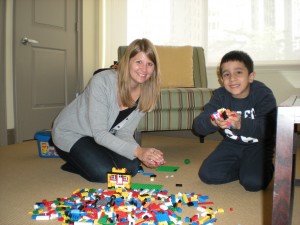
We are pleased to introduce our newest friend, Jai, to the Brooklyn Letters community! Jai and his mother, Varuna, reside in Delhi, India where Jai attended an English speaking school. For the next two months, they temporarily relocated to New York City and Jai will receive intensive speech-language therapy with a focus on literacy development: Craig provides services 1 day per week in his home-based office and Sarah provides services 4 days per week (sessions last 3 hours) in the family’s Manhattan apartment. Jai is a happy, bright, curious, and creative young boy who enjoys reading books, building with legos, playing computer games, and playing with Craig’s very cool pirate ship.
Jai recently participated in an evaluation in Delhi and it was recommended that he receive individualized speech-language and literacy intervention. Jai’s parents were unable to find adequate therapy services in India; they sought out therapy services in the U.S. and Varuna’s friend, in New Jersey, recommendeded Brooklyn Letters. Varuna spoke with Craig and Sarah and they felt that they were an excellent match for Jai. At the beginning of therapy, Jai’s interests, learning style, and strengths and deficits were assessed and baseline skill levels were established. Jai’s individualized treatment plan was developed and the overall goals of therapy are as follows:
• Facilitate Jai’s overall language and literacy skills.
• Work with Jai’s mother to teach strategies to support Jai’s learning, provide activities and materials for work at home, and increase her knowledge of language, literacy, and learning. Click here to see a video of Varuna explaining Jai’s homework.
• Provide suggestions for Jai’s teachers in India to implement in the classroom setting.
• HAVE FUN!

Specific intervention targets include:
1. Increase pre-literacy and literacy skills. To include sound/symbol awareness, auditory discrimination, and rhyming.
2. Increase expressive language skills by using 3-4 word utterances to request, protest, comment, and ask for help.
3. Increase accuracy of comprehension and use of spatial concepts and prepositions (in, out, on, under, next to, behind, in front)
4. Increase memory skills and use of strategies to increase visual and auditory memory.
5. Increase accuracy and speed of word retrieval and recall of information.
6. Increase accuracy of following 2 and 3-step directions.
7. Increase accuracy of response to WH question forms and open-ended questions.
8. Increase accuracy of use of age-appropriate syntactic/grammatical forms (plurals, regular and irregular past tense verbs).
9. Increase categorical and descriptive vocabulary skills.
10. Increase sustained attention to focused tasks.

Within the first week of therapy, Jai made significant progress with his language, literacy skills, and focus. He is producing utterances of increased length, using more complex language forms, and is more confident in his overall abilities. He increased his phonemic awareness skills and is able to identify words that begin with a specific sound. He is demonstrating improved learning readiness by increasing attention to structured tasks, self-monitoring his own level of engagement during activities, and learning spatial concepts, e.g. “under.”

We are excited to have the opportunity to work with Jai and look forward to joining him on his continuing journey of learning, growth, and development of skills! Great job, Jai!

Sarah is a Speech-Language Pathologist who provides home-based assessment and therapy services in the Park Slope and Carroll Gardens neighborhoods of Brooklyn, NY. She specializes in working with children and adolescents who have difficulty with articulation, phonology, language, fluency/stuttering, literacy skill development, pragmatics, and social language. Sarah develops individualized and evidence-based therapy plans that include frequent and ongoing collaboration with parents, caregivers, teachers, and educators in order to maximize the potential of each child. She can be reached at sarah@brooklynletters.com or www.brooklynletters.com

To learn more about Jai’s progress, please read the following blog- http://brooklynletters.com/2010/11/blog/part-ii-india-comes-to-brooklyn-by-sarah-stuntebeck-m-s-ccc-slp-speech-language-pathologist/
www.brooklynletters.com

Tags: , , , , , , , , , , , , , , , , , , , , , , , , , , , , , , ,


Enable Javascript